Childhood is precious and it is short
What the Government’s ‘Every Child Achieving and Thriving’ white paper means
This week saw the publication of the government’s long-awaited schools white paper, ‘Every Child Achieving and Thriving’, which sets out the future of education in England. The document focuses on broadening the curriculum, raising attainment for all pupils, and reforming how support is provided, particularly for children with special educational needs and disabilities (SEND). Central to these reforms is a new tiered model of support that replaces many of the existing Education, Health and Care Plans (EHCPs) with shorter, more flexible Individual Support Plans (ISPs) and earlier specialist help in mainstream schools. The Department for Education has a useful summary of the planned changes for parents here.
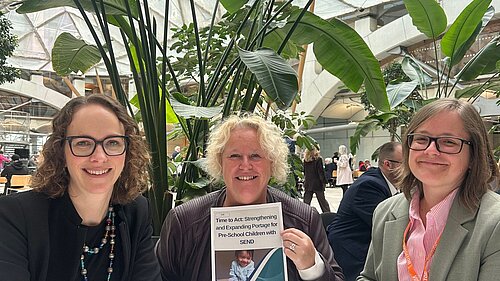
This week I have had conversations with professionals and parents who know what SEND provision in West Sussex is like from firsthand experience. I think everyone agrees that early intervention is vital, but people are cautious about whether what is being proposed will be able to do this. I have also heard concerns about whether the tiered ‘Individual Support Plans’ will actually be granular and flexible enough to properly meet the requirements that each individual child will have. Every child is unique and children with SEND shouldn’t be boxed into a category that doesn’t really fit them.
In terms of the practicalities, how quickly will these changes come in? Will schools, councils and early years providers be given what they need to realise the vision set out in the white paper? There is considerable uncertainty, and I think it will be years before we get the answers, let alone see meaningful improvements. As I said to ITV Meridian on Monday ‘childhood is precious and it is short’. When so many children have already been failed by the state, it is painful to know that the current plans are unlikely to see the change that is needed become a reality any time soon.
Two Liberal Democrat opposition day debates
The Liberal Democrats had our latest ‘opposition day’ debate in Parliament on Tuesday. This is where a party that is in opposition gets control of the day’s business. We split our time in half bringing two debates.
The first secured the agreement through a humble address for the government to release papers relating to the decision to make Andrew Mountbatten Windsor a trade envoy back in 2001.
The second debate enabled us to put forward our approach to social media regulation by age gating harmful platforms and content and put this to a vote. Concerns about children’s mental health, addictive algorithms and the way platforms push harmful content continue to grow across the UK, not just with parents, teachers and children’s charities, but with young people themselves.
What’s happening in Iran and the Middle East
This weekend’s unilateral military strikes by the United States and Israel against targets inside Iran mark a deeply dangerous escalation. These attacks, carried out without clear international authorisation or a coherent long-term strategy, are an illegal shortcut that risks igniting a wider regional war. At a time when tensions were already high, this action increases the danger to civilians across the Middle East and threatens to spiral beyond anyone’s control. For anyone in affected countries, I urge them to follow the travel advice from the Foreign, Commonwealth and Development Office.
None of this should be read as any defence of the Iranian regime. The clerical leadership in Tehran is authoritarian, repressive and profoundly dysfunctional. Its survival is clearly on the line, and it is acting accordingly. Only weeks ago it reportedly murdered thousands, perhaps tens of thousands, of its own citizens to crush domestic protests. Its rule rests not on consent, but on coercion: instruments of violence deployed ruthlessly against its own people and its external adversaries. It is corrupt, economically failing, and deeply unpopular with a population that is disaffected, restless and angry.
But recognising the regime’s brutality does not make reckless military escalation the right answer. In the past, it has been sustained diplomatic pressure and coordinated economic measures that have constrained Iran’s nuclear ambitions. Multilateral agreements and sanctions, however imperfect, achieved tangible limits on nuclear enrichment and inspection regimes. Military strikes, by contrast, risk strengthening hardliners, fuelling nationalism, and pushing nuclear activity further underground.
Perhaps most concerning is the absence of any credible plan for what comes next. Removing facilities or removing leadership through force does not in itself produce stability, democracy or security. If this regime is indeed doomed, the question is whether external military action hastens peaceful change or simply deepens chaos. History teaches us that power vacuums in fragile regions rarely produce liberal democracy overnight.
The priority now must be de-escalation. We need renewed diplomatic efforts, coordination with allies, and a clear commitment to international law. The people of Iran deserve freedom and accountable government, but they also deserve not to become collateral damage in a regional war.
Getting in touch
My parliamentary email address is: alison.bennett.mp@parliament.uk. If you need my help, please get in touch.
Best wishes,
Alison
PS: If you’ve enjoyed this week’s Monday Mail, please spread the word and tell your friends by forwarding it to them. Anyone can sign up here.