Alison Bennett's Monday Mail: In their footsteps

Welcome to my Monday Mail.
As your Liberal Democrat MP for Mid Sussex, I write a short email each Monday sharing what I have been doing and thinking about in the past week. Anyone can sign up to receive the Monday Mail, so feel free to share this email with friends and family who might be interested too.
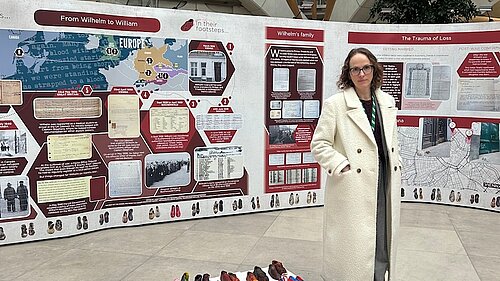
In their footsteps
It was Holocaust Memorial Day last Tuesday. During the week, I went to see In Their Footsteps, an exhibition on display in Portcullis House in Parliament. It really stayed with me. The ceramic shoes, each one representing a life ended by the Holocaust, are simple but powerful. Standing there, it was impossible not to think about the individuals behind the history. The exhibition was created by the daughter of a Holocaust survivor, and is now cared for by Learning from the Righteous. I was reminded of the value of personal reflection, education and our shared responsibility to remember and learn from the past.
Should we still have a hosepipe ban?
The longest month of the year is finally over, and in terms of the weather it certainly was not a dry January in Sussex. The good news is that Ardingly Reservoir is now full, you may recall that in September the water levels were extremely low.
At the start of last week, I wrote to David Hinton the CEO of South East Water asking when the hosepipe ban would be lifted. At the time of writing this newsletter, he has not replied to me..
However in an email to customers (of which I am one) sent on 28th January, the company has said the following:
We’re aware that it may seem strange for hosepipe restrictions to still be in place when it’s grey, cold and wet outside. The reason for this is our reliance on underground aquifers (underground layers of rock that hold water) for water supply and the fact it takes longer for groundwater to recover during the winter compared to our surface reservoirs.
In Sussex, we’re pleased to confirm that Ardingly Reservoir is now full and Arlington Reservoir is recovering well and is over 80 per cent full.
Groundwater makes up nearly 80 per cent of where your water comes from and it normally takes several months for aquifers to recharge over the winter. The dry weather we experienced last spring and summer led to groundwater levels falling to below average levels and so it is taking longer than normal for them to fully recover this winter despite the rainfall we have had.
It is only when we are confident that our water resources will recover do we remove restrictions. The weather this winter has been very helpful in supporting water level recovery, so we hope to be in a position to remove the restrictions soon.
My challenge back to South East Water, is that the Environment Agency says that since mid January, ‘Groundwater is now higher than average.’
So, the question is, who to believe?
On Friday, frustrated by the lack of response and the torrential rain, I launched a petition calling for the hosepipe ban to be lifted. If you have not already, please sign my petition to lift the hosepipe ban.
In the week ahead, I will be writing to South East Water once again, to get them to explain the difference between their account of groundwater levels, and the Environment Agency’s.
In the depths of winter, having a hosepipe ban isn’t the challenge for keen gardeners that it would be in the summer. That said, there are reasons why some folk may want to use a hosepipe right now (I for one am quite keen to get the pressure washer out and clean the moss off my driveway). However, it is just one more question that points to a failing leadership in the company. After the water outages across Sussex and Kent this winter, and endless burst pipes that take an age to get fixed, is it any wonder that so many of us no longer have confidence that the experts at South East Water have a hosepipe ban in place because it is necessary?
The Royal Sussex helipad
I was quoted in yesterday’s Sunday Times (£) about the spiralling costs and delays constructing the new helipad at the Royal Sussex County Hospital in Brighton. It goes without saying that investment across our hospitals is sorely needed, and if a helipad helps even a small number of the most seriously ill or injured patients reach specialist care faster, that matters..
However, this project has highlighted several challenges and failures that are worth noting. Originally expected to cost £5 to 7 million and be completed within two years, the helipad instead took nearly a decade to finish at a cost of £16 million. Its design and location on top of a 15-storey building near the coast mean it cannot operate at night, in very high winds, or in some weather conditions, making it unusable for at least half the time. After construction, further safety issues were discovered: rotor downwash could dislodge cladding or blow in windows of the neonatal intensive care unit, requiring additional reinforcement that cost £2.3 million and took three more years to complete.
The revised estimates suggest the helipad may serve as few as 23 extra patients a year, meaning the annual running costs of £453,000 are unlikely to be fully offset by NHS funding. My concern is not about the staff who work tirelessly at the hospital, nor about emergency care itself. It is about how major projects are planned, managed, and overseen, and whether lessons are being properly learned so that future investment delivers the greatest possible benefit for patients. Local people deserve both excellent healthcare and good stewardship of public money, and we must be able to achieve both.
Getting in touch
My parliamentary email address is: alison.bennett.mp@parliament.uk. If you need my help, please get in touch.
Best wishes,
Alison
PS: If you’ve enjoyed this week’s Monday Mail, please spread the word and tell your friends by forwarding it to them. Anyone can sign up here.